


Turia Natural Park: Valencia's Green Lung
This is, in a very brief summary, the Turia Natural Park. But across its more than 4,600 hectares, you are going to discover much more.
Because this protected natural area, a most worthy natural extension of the Turia Garden, is home to a diversity of ecosystems and species that inhabit the length and breadth of the municipalities through which they extend: Quart de Poblet, Manises, Paterna, Riba-roja de Túria, L'Eliana, Vilamarxant, Benaguasil, Llíria, and Pedralba.
And the landscape, as it could not be otherwise, portrays a typically Mediterranean forest.
But let's return to the capital, as from here, there is much to do.
Trails to Explore the Turia Natural Park
This park has endless trails that you can travel walking at a more or less brisk pace (that's up to you).
However, if you prefer two wheels or four legs, you will see that you also have options—take a look:
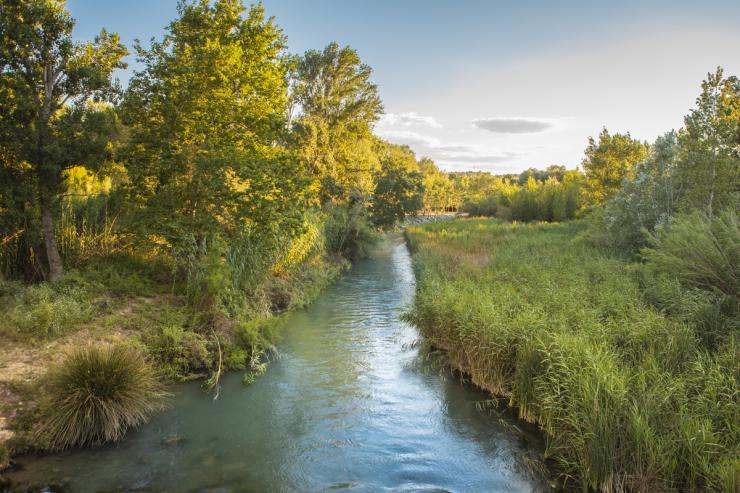
Main route via the Turia River Park
Before you lie 25 kilometers to explore along either of the riverbanks. But don't worry, during the itinerary you will find several rest areas in case you need a technical stop.
This route starts from Cabecera Park, in the capital, although if it suits you better, you can start from Llíria, Vilamarxant, or Riba-roja.
What is certain is that on the journey parallel to the Turia, you will come across no less than 19 wooden footbridges, which cross the river at different places of interest, among which we want to highlight the traditional crops of the Valencia Plain (Vega Valenciana).
You will also be able to see first-hand the Moncada irrigation canal, the most important of the Turia River, which irrigates all the fields between its path and the Mediterranean from west to east.
This route has a low difficulty level, making it ideal for families. You will see how the little ones enjoy watching squirrels and herons cross your path or pointing out the trout found in the river.
As we mentioned at the beginning, you can also complete this path by bike through different MTB routes where culture and nature go hand in hand throughout the entire journey.
Equestrian Route
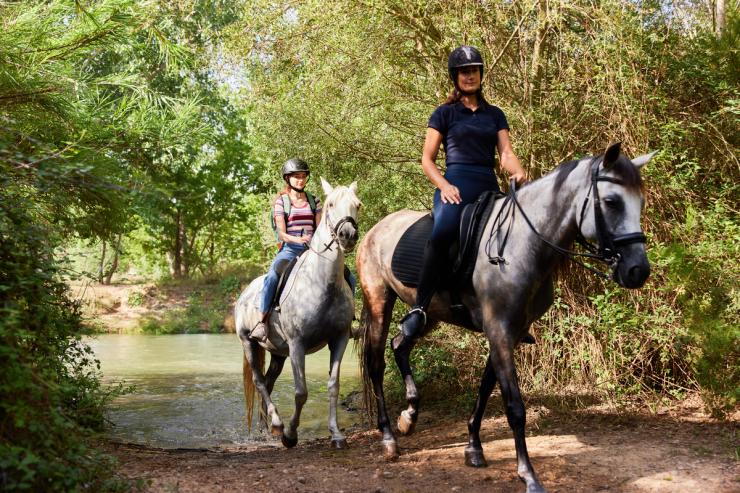
This IE-031 Equestrian Itinerary follows the course of the river on horseback through the Turia green corridor, with different routes (also green) that lead you to discover the ecological value of the park and its rich heritage.
Highlights include the Arab tower of Felx, the Hispano-Visigothic hillfort of Valencia la Vella, and the Lloma de Betxí archaeological site. Quite impressive.
This equestrian itinerary is one of the most complete in Spain because it has two distinct variants: one of 7.2 kilometers through the Vallesa forest (which we will introduce below) and another through Les Rodanes, of 12.8 kilometers.
Both, together with the 15.3 kilometers of the park, add up to exactly 35.3 kilometers of poplar and elm forests, undergrowth of aromatic plants, and Aleppo pines where you can walk peacefully with only the sounds of the forest for company.
But wait, it doesn't end there.
More Trails to Enjoy Valencian Nature
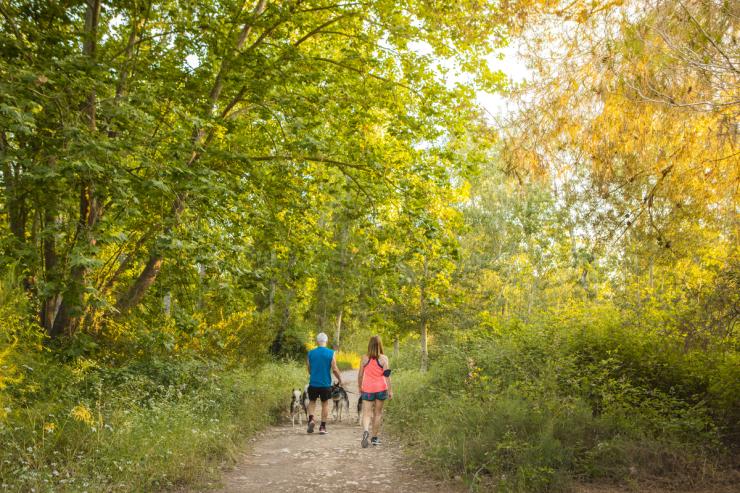
Such a natural setting offers a lot, and that is why within the park you have several itineraries, marked by colors, that lead you to discover different landscapes.
Here we show them to you briefly:
Yellow Route: Les Rodanes
Its 13 kilometers can be covered in about four and a half hours. It has a circular layout and medium difficulty.
It starts at the Bassa Barreta parking lot, passing through Rodana Gran, trenches built during the Civil War, Rodana del Pic, and Caballons.
Red Route: La Pea
It takes you along 13.5 kilometers near Peña Atrón, where birds of prey nest between December and May. It starts at the Molino parking lot in Pedralba and takes you through the Pedralba dam, Mount Chucheve, the Las Hoces del Turia viewpoint, the Cuatro Piedras area (if it's hot, you can cool off with a swim here), the La Pea hydroelectric plant, and the Troneta viewpoint. It has medium difficulty and reaches an altitude of 210 meters above sea level.
Blue Route: El Palmeral
This is another circular route of 11.9 kilometers and medium difficulty. It also starts at the Molino parking lot in Pedralba, passing through landmarks such as the Virgen de Luján chapel, Mount Palmeral, the ravine and the Pedrera cave, and the Palmeral path.
On this route, you can see examples of dry-stone architectural heritage with constructions such as cisterns, "catxirulos" (traditional huts), and walls.
Purple Route: Water
This trail runs for 9 kilometers between agricultural roads and forest paths. The route highlights the architectural heritage related to water and the historical use for irrigation in this area.
It links the La Pea route with the Turia River Park and you can choose between starting at the municipal laundry in Villamarxant or from the Visitor Center.
Pink Route: La Vallesa
It is the shortest route of all, with only 3.1 kilometers and low difficulty. It begins in the La Vallesa residential area in Paterna and crosses the forest of the same name.
This place is the link between civilization and nature in the Valencia metropolitan area, a spot so impressive that we have dedicated a special section to it right below.
Natural Spots in the Turia Natural Park
Since we are getting into it, we don't want to miss the chance to introduce you to other natural spaces that also have magnificent environmental value and are a good option for spending a day away from the city bustle.
La Vallesa Forest
La Vallesa is a park with great biodiversity, both plant and animal. Look closely:
- If we focus on the flora, typical Mediterranean species live here, such as the Aleppo pine, the olive tree, and the carob tree. A little closer to the ground, Mediterranean scrub emerges with specimens such as kermes oaks, gorse, rosemary, thyme, and mastic.
- Moving on to the fauna, you will find countless species: eagles, owls, barn owls, frogs, toads, snakes, rabbits, beech martens, weasels, genets, foxes, wild boars, and squirrels, which are just a part of the cast.
We cannot fail to mention that La Vallesa is home to the Silky Anthyllis (albaida sedosa), an endemic plant species with a very striking lilac color that finds here one of the best (and few) populations worldwide.
The cloak of colors, so present in this forest, is completed by other wild floral species, seasoned with the characteristic scent of rosemary and thyme.
If you decide to visit, you will pass through various environments such as pine forests, a mountain regenerating after a fire, and dryland crops.
But don't worry, you don't have to study too much beforehand. Along the way, there are information signs that tell you in full detail the specifics of each of the ecosystems you pass through.
Additionally, if hunger strikes, you can stop at one of the sustainable restaurants located in the surrounding area.
The Turia River Park
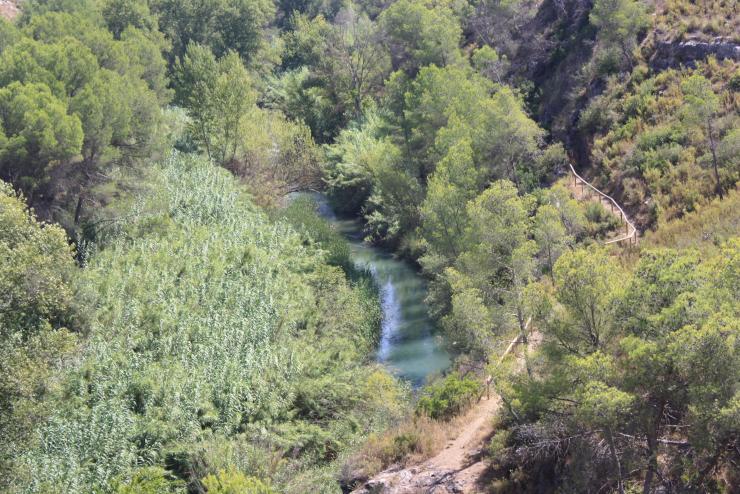
It covers 30 kilometers extending along the Turia riverbed. It begins in Vilamarxant and reaches its mouth in Valencia city.
However, the best part, as you can imagine, is found along its route.
Heritage is also very present here, thanks to the remains showing the passage of different civilizations throughout history, where the river, as a source of life, has been the undisputed protagonist.
Roman and Arab aqueducts and canals, remains of irrigation ditches, water engines, cisterns, and "catxirulos" are some examples.
But nature is the strong point. The riverbank gives an extraordinary richness to the environment with species such as the white poplar, black poplar, white willow, and osiers, which form small forests.
Once in the water, vegetation continues to make its way with species such as reeds, bulrushes, and rushes.
And if we look at animal life, it follows the same pattern: more than 150 vertebrate species live here, from amphibians, reptiles, and fish to birds and mammals.
The Turia Park Visitor Center
The Park also has a Visitor Center, which is available to answer any questions or queries from visitors and receive ideas and suggestions of all kinds.
It is located in Vilamarxant, exactly at CV-50 - PK 87.200 at Pont de la Barca. However, if you want to contact the center, you can do so by phone at 961 325 162 and 660 127 250.


